A sales playbook template is a short document that writes down how your company wins a deal: who buys, why they buy now, what you say, how the call runs, how a deal moves to signed, and the numbers that tell you it's working. Before your first sales hire, it should be about seven parts long and filled in from deals you've already closed, not from theory.
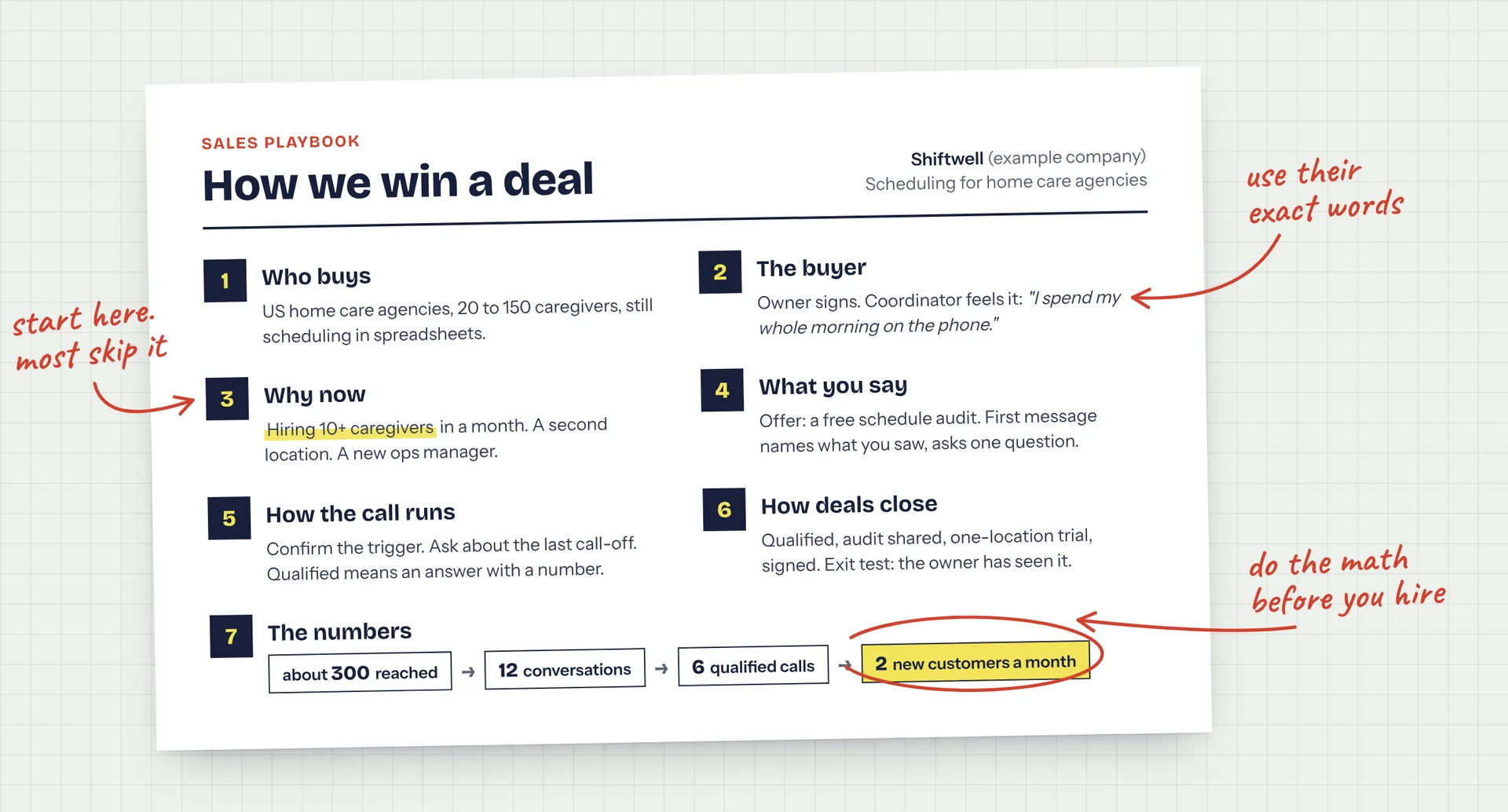
The whole playbook on one page, filled in for Shiftwell, a made-up example company. Each part answers one question a new rep would otherwise ask you.
What goes in a startup sales playbook?
Most templates you'll find online were written for sales teams of 50. They have sections for mission statements, territory plans and battlecards for competitors you've never met. A startup needs less, but each part has to be specific.
| Part | The question it answers | What "filled in" looks like |
|---|---|---|
| 1. Who buys | Which companies are a fit? | Industry, size, and the one thing they all have in common |
| 2. The buyer | Who signs, and who feels the pain? | Title, what their week looks like, the words they use |
| 3. Why now | What happens right before they buy? | Three to five events you can spot from the outside |
| 4. What you say | What do you offer, and how do you open? | One offer per trigger, and the first message for each |
| 5. How the call runs | What happens on the first call? | The questions to ask, in order, and what a good answer sounds like |
| 6. How deals close | What are the stages, and what moves a deal forward? | Stage names with a clear exit test for each |
| 7. The numbers | What has to be true for this to work? | Reach, replies, calls and wins per month, worked backward from your goal |
The order matters. Parts 1 to 3 decide who you talk to, and they're where most founders' knowledge is thinnest on paper and deepest in their head.
Why write it before your first sales hire?
Because your first rep can't read your mind, and ramping without a map is slow and expensive. In a 2023 Bridge Group study of B2B SaaS reps, about four in ten took more than five months to ramp (summary of the study). Every month of that is salary without pipeline.
The bigger risk is quieter. A new rep with no playbook doesn't fail loudly, they stall on who to reach out to. They default to a generic list, send generic messages and get generic results. Then everyone concludes the rep was the problem.
The playbook also does something for you. Writing it forces you to separate what's actually repeatable from what worked because you're the founder and you know everyone.
The template
Copy this into a doc and fill in each line. One or two sentences per line is enough. If a line takes a paragraph, you probably haven't decided yet.
PART 1: WHO BUYS Industry: Company size (people or revenue): What every good-fit customer has in common: Who is NOT a fit, and why:
PART 2: THE BUYER Title of the person who signs: Title of the person who feels the problem daily: Their week before you (in their words): Their week after you:
PART 3: WHY NOW (buying signals) Event 1 that happens right before they buy: Event 2: Event 3: Where each event shows up (job post, news, website change, etc.):
PART 4: WHAT YOU SAY Offer for each event: First message for each event (under 100 words): The one proof point you lead with:
PART 5: HOW THE CALL RUNS First 2 minutes: 5 discovery questions, in order: What a qualified answer sounds like: How you end the call (the next step you ask for):
PART 6: HOW DEALS CLOSE Stages, with the exit test for each: Who has to be involved before signing: Common reasons deals stall, and what you do:
PART 7: THE NUMBERS Monthly goal (new customers): Close rate from qualified call: Qualified calls needed: Reply rate and companies to reach per month:
A filled-in example
Here's the same template filled in for Shiftwell, a made-up company that sells scheduling software to home care agencies with 20 to 150 caregivers. The details are invented, but the shape is what a real one looks like.
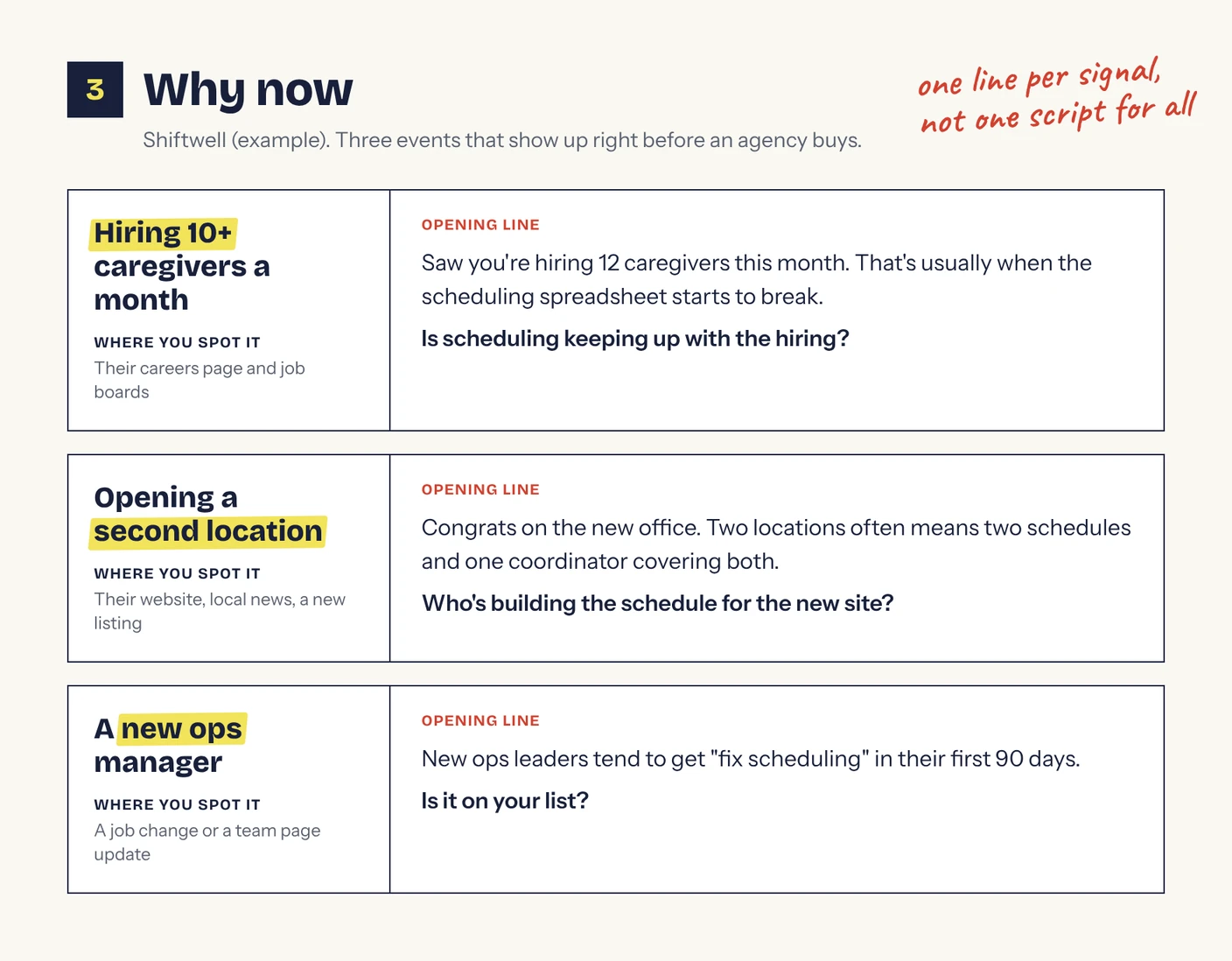
Part 3 does the most work. Each signal comes with where to spot it and the opening line that goes with it.
Who buys. Home care agencies in the US with 20 to 150 caregivers, still scheduling in spreadsheets or the scheduling tab of their billing system. Not a fit: agencies under 10 caregivers (the owner schedules from memory and that's fine) and hospital-owned agencies (procurement takes a year).
The buyer. The owner signs. The scheduling coordinator feels the pain: filling call-offs by text at 6am, re-sending the week's schedule three times. In their words: "I spend my whole morning on the phone."
Why now. Three events show up right before an agency buys. They post jobs for 10 or more caregivers in a month (growth breaks the spreadsheet). They open a second location. Or they hire a new operations manager, who is told to "fix scheduling" in their first 90 days.
What you say. For the hiring signal, the offer is a free schedule audit: send last month's schedule and get back where the gaps and overtime came from. The first message names what you saw, the problem it causes, and asks one easy question. No product tour in the first email.
How the call runs. Open by confirming what you saw ("You're hiring 12 caregivers this month"). Then ask about the last call-off that went wrong, how long a schedule takes to build, and what happens when the coordinator is out sick. A qualified answer has a number in it: hours, missed visits or overtime dollars.
How deals close. Four stages: qualified (pain with a number), audit shared, trial with one location, signed. The exit test for "audit shared" is that the owner has seen it, not just the coordinator.
The numbers. This is where most templates stop being useful, so it gets its own picture.
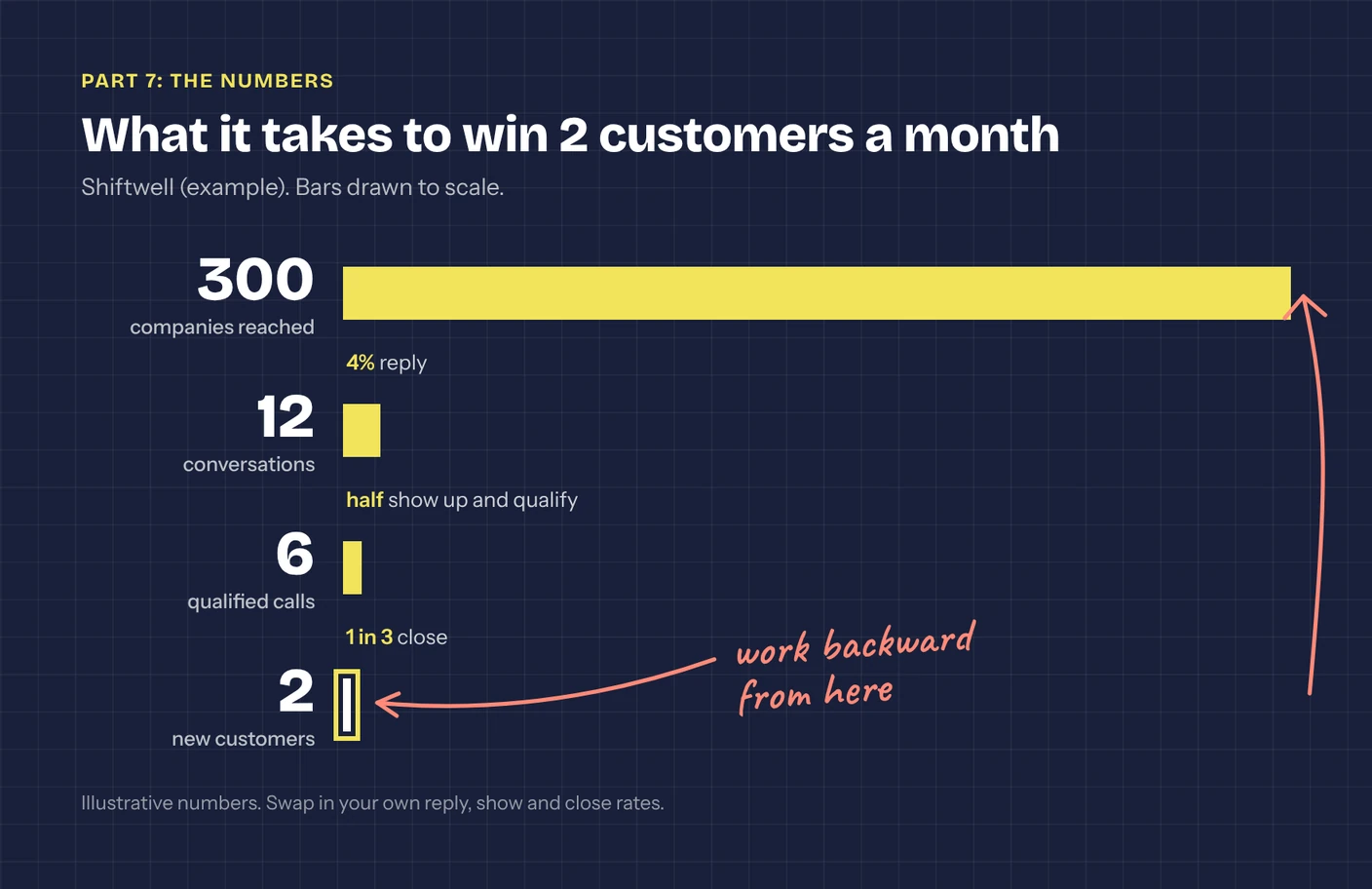
Work backward from the goal. If the goal is 2 new customers a month and a third of qualified calls close, you need 6 qualified calls. At a 50% show-and-qualify rate that's 12 conversations, and at a 4% reply rate that's about 300 companies reached. Illustrative numbers; use your own.
How to fill it in from deals you've already won
- Pull your last 10 closed deals. Lost deals too, if you have them. You're looking for patterns, and 10 is enough to see them.
- Find what happened right before each one. A hire, a funding round, a new location, a new leader, a tool they outgrew. If the same event shows up three times, it's a buying signal.
- Copy the words buyers used. From emails, call notes, the form they filled in. Your messages should sound like them, not like your website.
- Write down the call you actually run. Not the ideal call. The questions you ask, in the order you ask them, and the moment you know it's a fit.
- Do the math backward. Start from the number of customers you need and work back to how many companies you have to reach. If the number is impossible, change the plan now, not after the hire.
- Hand it to someone and watch where they stall. A friend, an advisor, your new rep on day one. Every question they ask is a gap in the playbook.
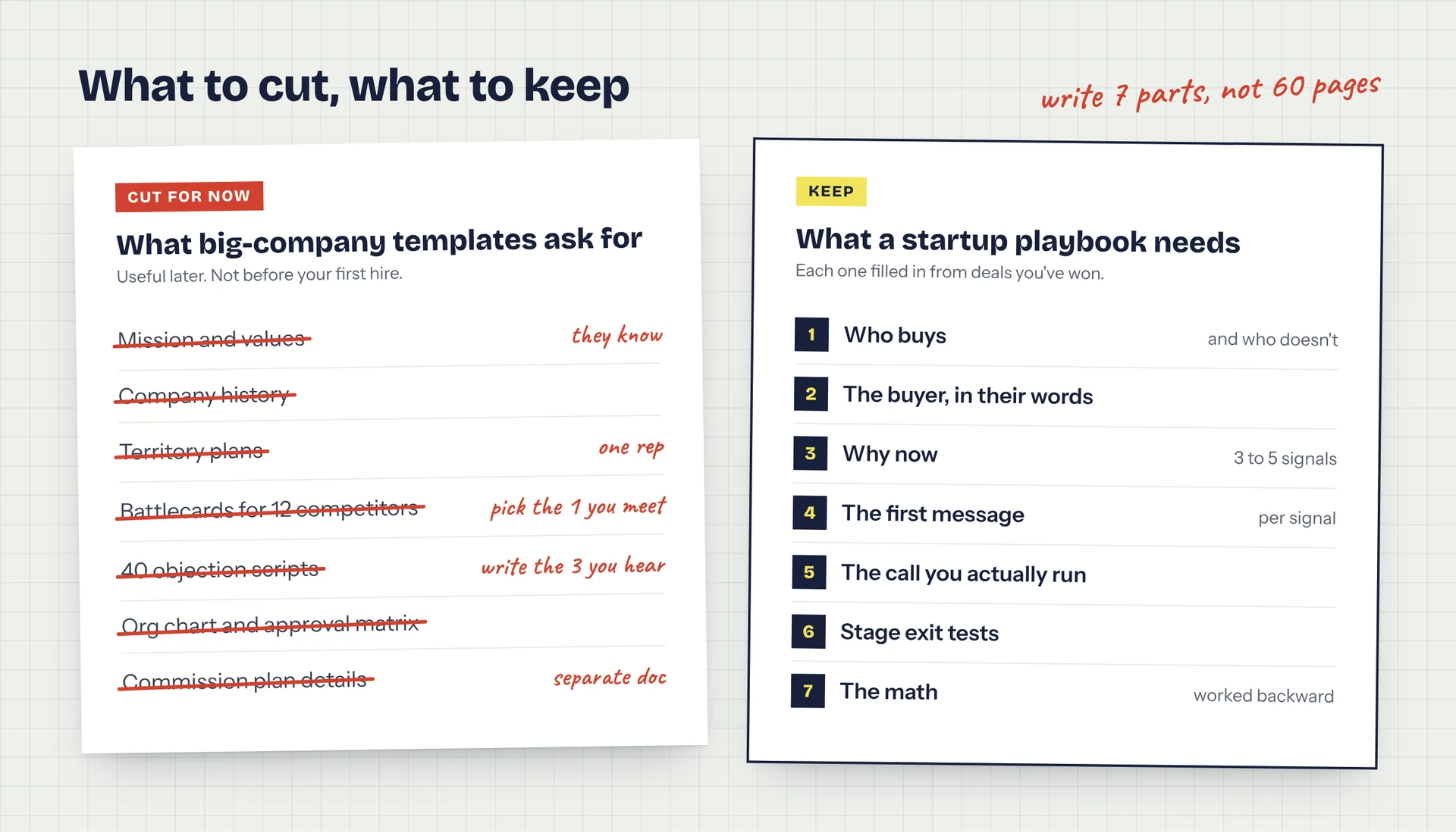
What to cut and what to keep. Most of what a big-company template asks for can wait until you have a sales team.
The three parts most founders skip
Why now. Founders know who buys but rarely write down when. Without it, your rep reaches out to good-fit companies at the wrong moment and hears "not right now" all day.
The numbers. A playbook without the math is a style guide. The numbers tell you whether the plan can reach the goal before you've spent six months finding out.
The exit test for each stage. "Demo done" isn't a stage exit. "The person who signs has seen the price" is. Clear exits are what make your forecast honest.
When a template stops being enough
A template gets your knowledge out of your head. The harder part is keeping it true: buyers change, new signals appear, and the first messages that worked in spring stop working by fall. A playbook nobody opens after week one is worth about as much as no playbook. The value is in using it every week and updating it when a deal surprises you.
That's the job of a playbook: to be the brain behind the outreach, not a file in a folder. If you want a head start, start with your free buyer page. It covers parts 1 and 2 for your company in about five minutes, no call and no card. And if you're deciding whether it's time to hire, the first sales hire quiz will tell you which hire fits where you are.
Questions
- What is a sales playbook template?
- A short document with a fixed set of sections that writes down how your company wins a deal: who buys, why they buy now, what you say, how the call runs, how deals close, and the numbers. You fill it in from real deals so a new rep can follow it.
- How long should a startup sales playbook be?
- Seven parts, usually a few pages. One or two sentences per line is enough. If a line needs a paragraph, the decision behind it probably hasn't been made yet.
- When should a startup write its sales playbook?
- Before the first sales hire, while the founder is still closing deals and remembers why buyers said yes. Writing it after the hire means the rep ramps without a map.
- What is the difference between a sales playbook and a sales process?
- The sales process is the stages a deal moves through. The playbook includes the process, plus who to sell to, why they buy now, what to say and the numbers that tell you it's working.